PR is often misunderstood as a job of sending press releases, following up with journalists and getting coverage. But anyone who has actually worked in public relations knows that it is much more than that.
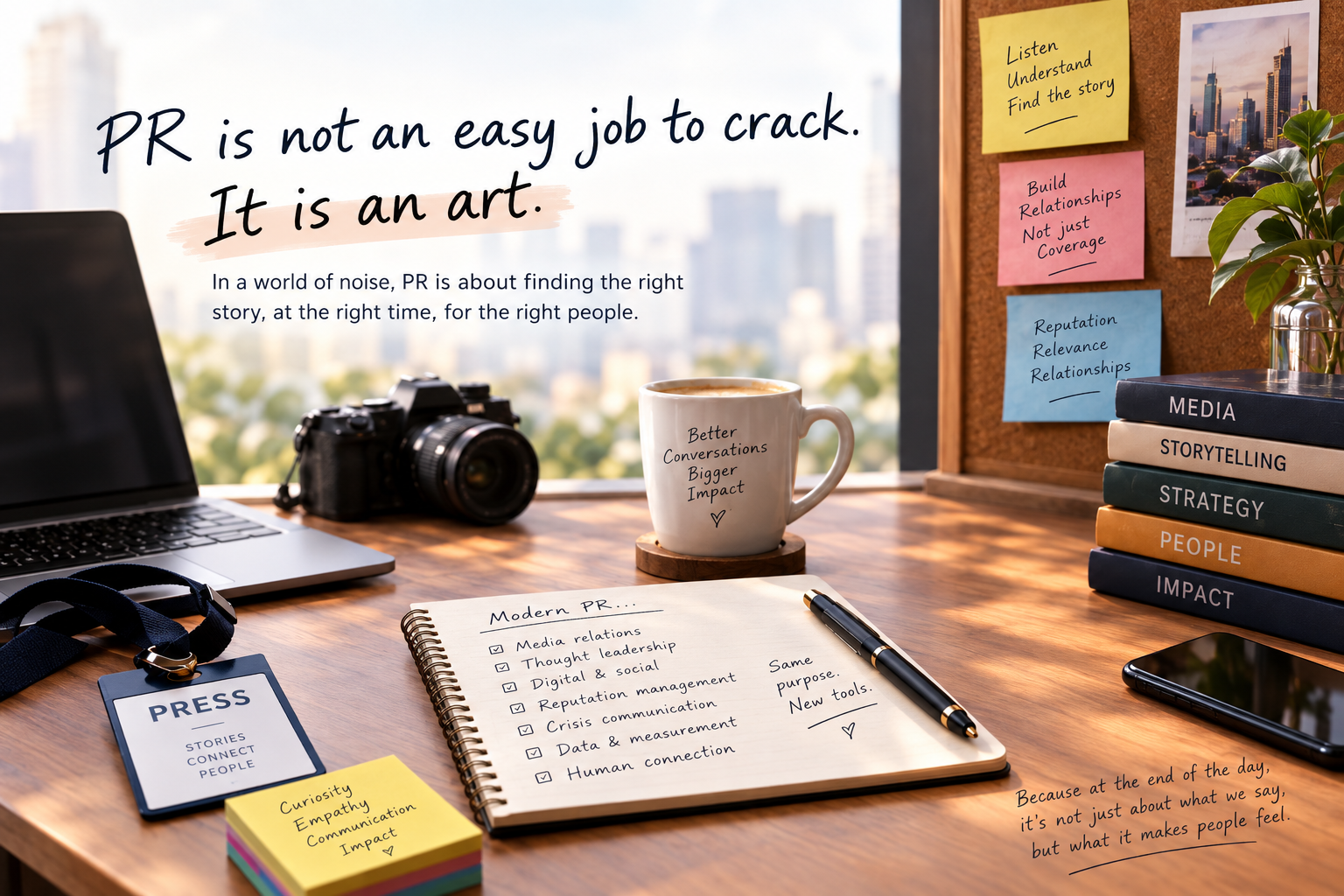
PR is not an easy job to crack. It is an art.
An art of understanding people, stories, timing, conversations and, most importantly, perception.
Over the years, I have realised that good PR is not about how many emails you send or how many media mentions you can show in a report. It is about knowing what makes a story relevant, which journalist would genuinely be interested in it, when to pitch it and how to present it without making it sound like an advertisement.
Modern-day PR has changed dramatically. Earlier, the conversation was largely about newspapers, television, magazines and press conferences. Today, the media landscape is much wider. Digital publications, social media, podcasts, newsletters, creators, influencers and online communities have all become part of the communication ecosystem.
But one thing has not changed: people still connect with stories, not advertisements.
That is where the real art of PR comes in.
As PR professionals, we are constantly trying to find the story behind the story. A company may want to talk about its latest product, but a journalist may be more interested in the changing consumer behaviour behind that product. An entrepreneur may want to talk about business growth, while the more interesting story could be the problem they identified and the journey that led them to build the business.
PR today is about making that connection.
It is also about understanding journalists. Every journalist has a different beat, writing style, audience and editorial requirement. A technology journalist may look at a story very differently from a business journalist, while a lifestyle journalist may look for a completely different human angle.
Sending the same pitch to everyone is not PR. Understanding who should hear the story and why is.
And then comes the most underrated part of PR: relationships.
Relationships in PR cannot be built only when you need a story. They are built over time, through credibility, respect and understanding. A good journalist should know that when a PR professional calls, there is a reason for the conversation. Similarly, a PR professional needs to respect a journalist's time, deadlines and editorial judgement.
Modern PR also demands much more from a professional. You need to understand your client's business, industry, competition, news cycle and audience. You need to know what is trending, but you also need to know whether a trend genuinely makes sense for your client.
Sometimes, the best PR idea is not the loudest one.
It is the one that is timely, relevant and authentic.
Today, PR professionals are also expected to be storytellers, researchers, strategists, relationship managers and crisis communicators. We have to constantly consume information, understand the conversations happening around us and identify opportunities before they become obvious.
And yes, there is pressure.
There are days when you pitch ten stories and hear nothing back. There are days when you work on an article for hours and it does not get published. There are days when a story you thought would work brilliantly simply does not find a place in the news cycle.
But that is also PR.
You learn to take rejection without taking it personally. You go back to the drawing board. You find another angle. You make another call. You rewrite the pitch. You wait for the right moment.
Because PR is not always about getting a "yes".
Sometimes, it is about knowing why you got a "no" and what you can do differently the next time.
For me, modern PR is about creating meaningful visibility rather than simply creating noise.
It is about making a brand, organisation or individual part of a larger conversation.
It is about asking: Why should anyone care about this story?
If we cannot answer that question, no amount of follow-ups can make a story truly compelling.
The tools of PR may keep changing. The media landscape will continue to evolve. AI will change how we research, write and communicate. Social media platforms will come and go.
But the heart of PR will remain human.
Understanding people. Building trust. Finding the right story. Creating the right conversation. And knowing when to speak and when to listen.
That, to me, is the real art of PR.
Because PR is not just about getting your name in the news.
It is about giving people a reason to remember your story.