After 14 years in public relations, I have realised that PR is one profession where no two days are ever the same. One day, you are planning a press conference; the next, you are chasing a journalist for a confirmation; and on another day, you are sitting with a client, trying to explain why a particular announcement may not necessarily become news.
When I started my journey in PR, a large part of our work revolved around press releases, media lists, phone calls, press meets and events. Today, the ecosystem has changed significantly. The platforms have changed, the speed has changed, and the way people consume news has changed. But one thing has remained constant: a PR professional still has to understand what makes a story worth telling.
And that, according to me, is where the real skill lies.
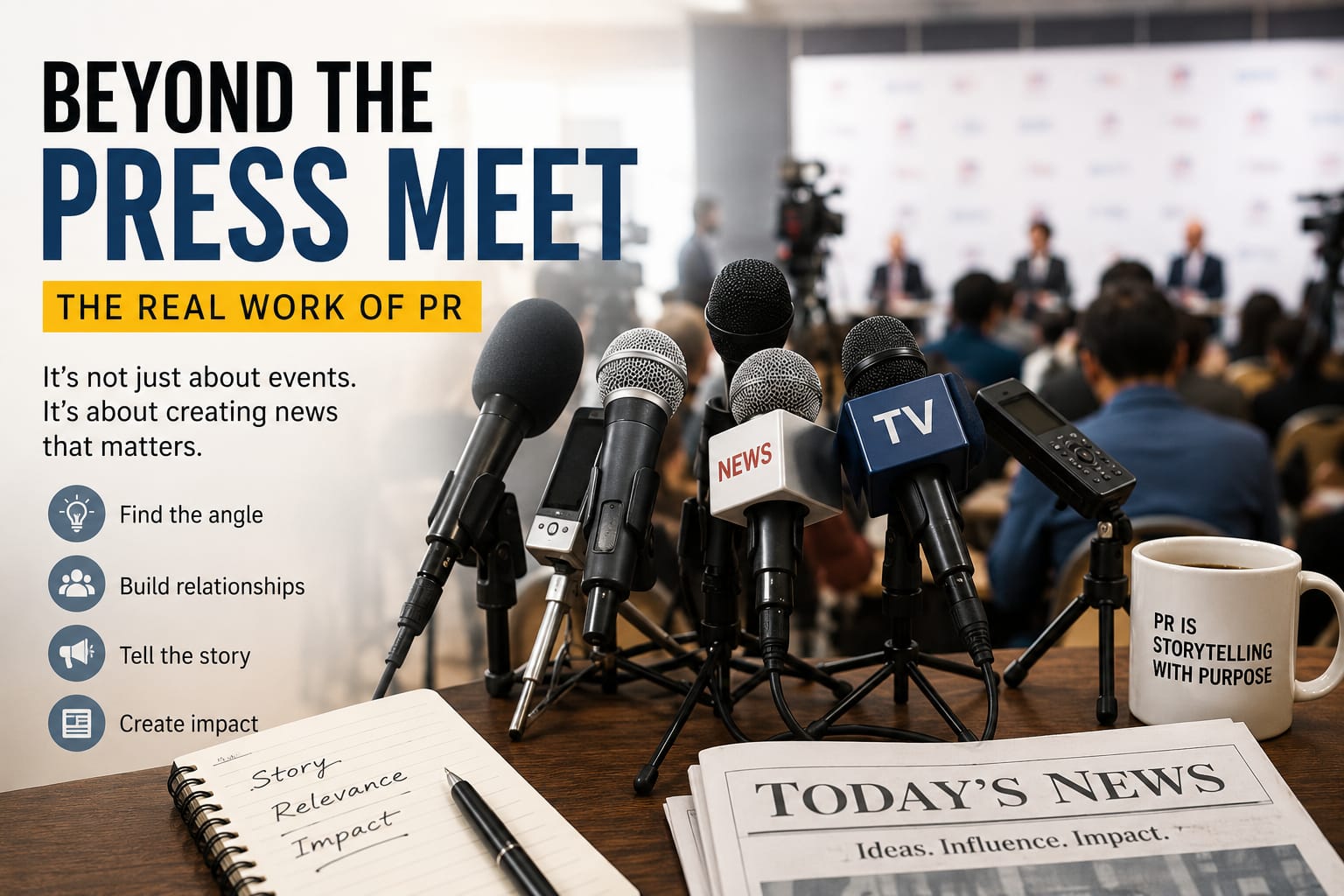
A Press Meet Is Not the Story
One of the biggest lessons I have learnt over the years is that organising a press meet does not automatically mean you have a news story.
A beautifully organised venue, a good guest list, branded backdrops and a room full of journalists can create a successful event. But the journalist will still ask the most important question: “What is the news?”
This is something PR professionals sometimes forget.
An event is a platform. The news is the substance.
I have seen situations where a client is extremely excited about an event, while the PR team is trying to find the one strong angle that can make the event relevant to the media. This is where experience matters. You need to look beyond the event and identify the larger story.
What does this announcement change?
Who will benefit from it?
Why should a reader care?
What is different about it?
What is the larger industry or social relevance?
These questions often create a better story than the event itself.
The Journalist Is Not Attending for Us
Another thing 14 years in PR has taught me is to respect the journalist’s time.
We often say, “We have invited 30 journalists,” as if the number itself defines success. It doesn’t.
A journalist is not attending a press meet to make the PR team’s attendance sheet look good. They are there because they believe there could be something relevant for their audience.
This understanding completely changes the way we approach media relations.
Instead of simply asking journalists to “please cover the event”, we need to tell them why the event matters.
A good PR professional should be able to explain the news angle in two or three sentences. If we cannot explain the relevance ourselves, expecting a journalist to find it is unfair.
Events Have Changed, but Relationships Still Matter
The PR industry has become much faster. WhatsApp messages, emails, digital publications, social media and instant updates have made communication easier. At the same time, they have also made journalists more accessible—and consequently, more approached.
This has made genuine relationships even more important.
A journalist may not cover every story you send. That does not mean the relationship is over.
PR is not about calling someone only when you have a press release. It is about understanding their beat, knowing what they write about and respecting their deadlines and editorial choices.
Over the years, I have learnt that a simple conversation can sometimes be more valuable than ten generic pitches.
Media relations is not a transaction. It is a relationship built over time.
Not Every Event Needs a Press Conference
This is another lesson I wish more brands and organisations understood.
Sometimes, the best PR strategy is not a press meet.
A small interaction with a few relevant journalists may work better. Sometimes, an exclusive interview is stronger. Sometimes, a thought-leadership article can create more impact. Sometimes, a data-led story is the right approach. And sometimes, honestly, there may not be enough news to call a press conference.
Saying this to a client can be difficult.
But PR professionals should not simply become event managers for the media. Our job is to create communication opportunities that have editorial value.
A packed press conference may look impressive internally. But ten meaningful stories reaching the right audience can be far more valuable.
The Pressure to Create News
One of the most challenging parts of PR is the constant expectation to “get coverage.”
I have experienced this many times.
There are days when you have worked hard, spoken to journalists, followed up, shared information and still don’t get the coverage you expected. There are also days when one small conversation results in a story you never anticipated.
This unpredictability is part of PR.
We cannot control what becomes news.
We can only control the quality of our pitch, the relevance of the story, our relationships and how well we understand the media.
That is why I believe PR professionals need to stop measuring themselves only by the number of articles.
The better question is: Did we create the right conversation?
From Getting Coverage to Creating Conversations
PR today is no longer just about putting a brand in the newspaper.
It is about creating a conversation around the brand.
A good PR campaign can take an announcement and connect it to a larger industry trend. It can turn a company initiative into a human-interest story. It can bring an expert into a conversation that is already happening.
This requires curiosity.
You need to read the news every day. You need to know what journalists are talking about. You need to understand the industry you are working in. You need to know what is happening beyond your client’s press release.
After 14 years, I still believe that one of the strongest tools in PR is something very basic: reading.
Read newspapers. Read digital publications. Read opinion pieces. Read what journalists write. Understand headlines. Notice what stories get picked up and, equally importantly, what stories don’t.
It teaches you more than any media list ever can.
PR Professionals Are Becoming Storytellers
The role of a PR professional has changed considerably during my career.
Today, we are expected to understand content, digital platforms, social media, influencers, thought leadership and sometimes even data and technology. But underneath all of this, storytelling remains at the heart of PR.
The tools may change.
The platforms may change.
The newsroom may change.
But people will always want a good story.
And perhaps this is why, even after 14 years, I still find PR exciting.
There is always another journalist to speak to, another story to discover, another event to plan and another client to convince that the strongest news angle may not always be the one sitting in their press release.
For me, PR has never been just about getting someone into a room for a press meet.
It is about understanding why the room should matter in the first place.
And after 14 years, that is probably the biggest lesson I carry with me.