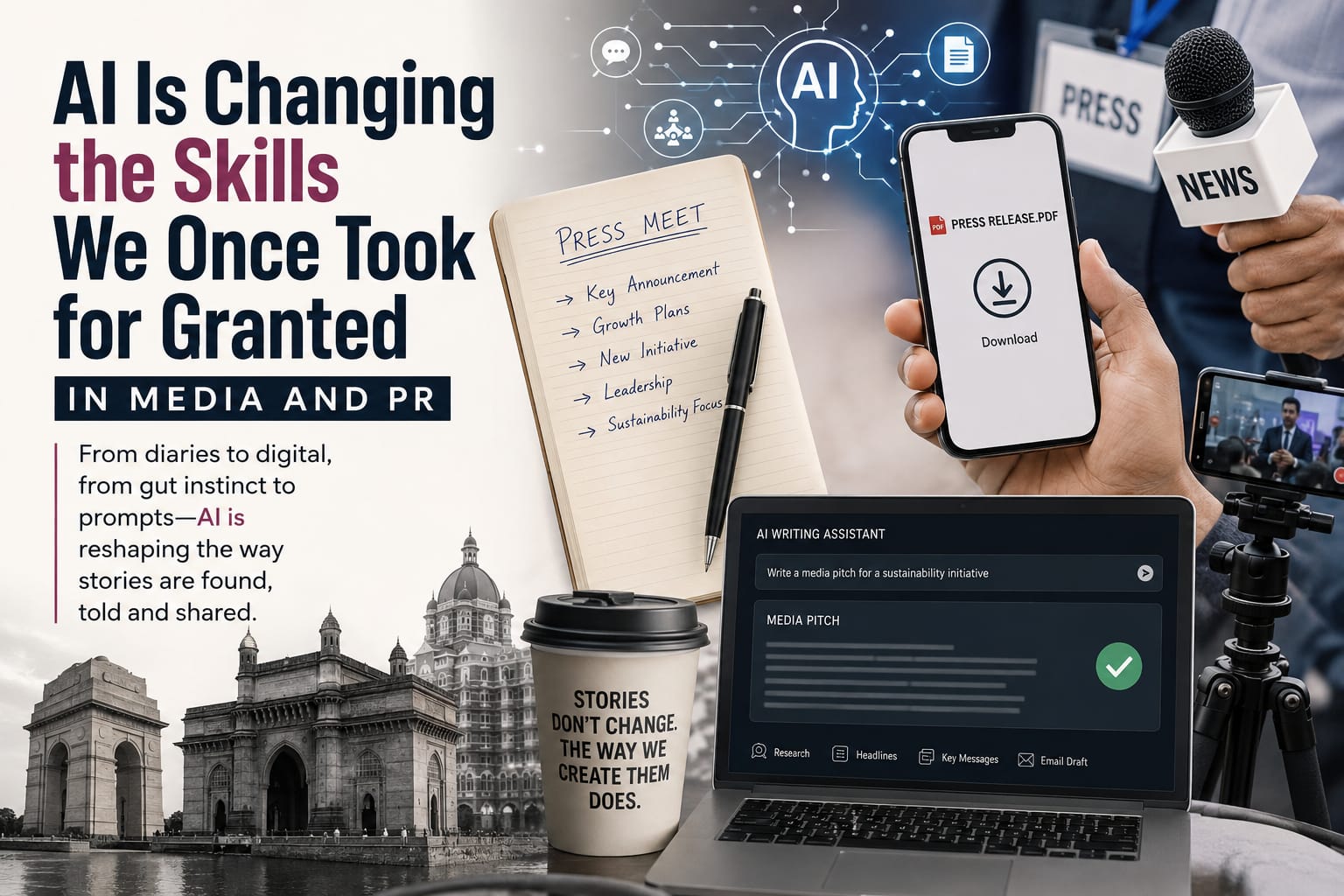
There was a time when a journalist walked into a press conference with a diary and a pen, sat through the entire interaction, and carefully noted down the important points. The diary was not just a place to write quotes. It was often where a journalist captured the mood of the room, a speaker’s important observation, a follow-up question, and sometimes even an idea for a future story.
Today, the diary has largely been replaced by a smartphone, and in many cases, even the need to write everything down has reduced. Instead of asking for a printed press release, journalists often ask for the PDF to be shared directly on WhatsApp or email. Instead of carrying a tripod or separate recording equipment, a mobile phone is enough to record a byte, shoot a quick video, or capture visuals for a digital story.
From Diary and Pen to PDF and Phone
Technology has made journalism faster and more convenient, but it has also quietly changed some of the basic skills that once came naturally to people entering the profession.
A mass communication student who once had to listen carefully, take notes, identify the most important point, and then write a story from those notes can now record an entire interaction on a phone and use technology to transcribe, summarise, or structure the information.
The convenience is undeniable. The concern is whether the habit of listening, observing and processing information independently is slowly becoming weaker.
When the First Draft Comes From a Prompt
The same change is visible in public relations.
Earlier, a PR professional would sit with a brief, understand the client, identify the news angle and draft a pitch in their own words. They would think about which journalist would be interested, what would make the subject relevant to that publication and how the story could be presented without sounding like an advertisement.
Today, a PR professional can give a command to an AI tool and get a pitch, headline, email or even an entire media note within seconds.
The technology can make the first draft much faster, but the ability to create a good pitch still depends on something AI cannot automatically provide: an understanding of the journalist, the publication, the news cycle and the client’s actual story.
AI Can Write the Pitch, But Can It Find the Story?
This is where the conversation around AI and jobs needs more nuance.
AI is not simply taking away jobs or replacing skills. It is changing which skills people need to develop and which skills they may stop practising because technology is doing the work for them.
For a young person studying mass communication, journalism or public relations, this distinction is extremely important.
If a student never learns to write a news story independently because AI can produce one, they may become efficient with a tool but weak in the fundamental skill.
If a PR executive never learns how to develop a media angle because AI can generate ten pitch ideas, they may eventually struggle to identify which of those ten ideas is actually newsworthy.
Ten Ideas in Ten Seconds, But Which One Is Newsworthy?
There is also a difference between generating content and understanding communication.
AI can produce a beautifully structured pitch, but it does not automatically know that a particular journalist does not cover that subject, that a publication has already carried a similar story, that an editor is looking for a different angle or that a particular quote does not sound like the person who is supposed to have said it.
Those decisions still require human understanding and professional judgement.
The media industry itself shows us how quickly these habits can change. A journalist once needed to manually take notes during a press meet. Today, a phone can record the entire conversation. A press release that once had to be physically collected can now be shared digitally within seconds.
A journalist who once spent time typing and rewriting every piece of information can now use transcription and AI-assisted tools to speed up the process.
These are positive developments because they save time and allow journalists to focus on reporting. But there is a danger if convenience replaces learning.
The PR Professional Is Becoming the Editor of AI
The same applies to PR.
A young PR professional can now research a subject, develop possible headlines, draft a pitch, create follow-up messages, and even prepare questions for an interview with the help of AI.
This can be incredibly useful, especially when teams are working under tight deadlines.
But the professional still needs to know what to ask AI for, what information to provide, what to reject, and what to rewrite.
A weak brief will usually produce a weak result, no matter how sophisticated the tool is.
The Skill Is Moving From Writing to Knowing What to Keep
This is perhaps where the biggest change is taking place.
Earlier, the skill was often in producing the first draft. Today, the skill is increasingly in knowing how to guide, question, and improve that first draft.
But that does not mean the original skill should disappear. In fact, it becomes even more important because you cannot effectively edit something you do not understand.
Don’t Let AI Become Your Shortcut to Learning
For mass communication and journalism students, this means the basics still matter.
They need to learn how to write, report, observe, research, ask questions, conduct interviews, identify a news angle, and understand the difference between information and a story.
They should know how to write a press release without AI before asking AI to improve one. They should know how to write a pitch before asking a tool to generate one. They should be able to listen to a speaker and identify the strongest quote without depending entirely on a transcript.
Your Network Still Matters More Than Your Prompt
For PR professionals, the role is also changing.
The value of a PR person will increasingly lie less in simply producing content and more in understanding people, media and context.
Knowing which journalist to approach, what angle to pitch, when to pitch it, how to build a relationship and how to position a story cannot be reduced to a prompt.
AI can support these activities, but it cannot replace the professional judgement built through real interactions with journalists and an understanding of how newsrooms work.
The Real Risk Is Not AI. It Is Losing the Basics.
There is also a larger lesson here for young professionals entering the media and communications industry.
Technology will continue to take over repetitive tasks. That is not something we should necessarily resist. The real risk is allowing technology to take away the opportunity to learn the skills behind those tasks.
If AI writes every first draft, someone may never learn how to write.
If AI generates every pitch, someone may never learn how to think like a journalist.
If AI summarises every interview, someone may stop learning how to listen.
The answer is not to stay away from AI. That would be unrealistic and unnecessary.
The answer is to use AI without allowing it to replace the learning process. Let AI make the work faster, but do not let it make you less capable.
The journalist of the future may not carry a diary or tripod to every press meet. The PR professional may not spend an hour writing the first version of a pitch.
That is not necessarily a problem.
What matters is whether the person holding the smartphone or giving the prompt still has the ability to understand what is happening, identify what matters and communicate it effectively.
Technology can make communication faster. It can make professionals more productive. But the fundamentals of journalism and public relations remain human.
The ability to listen, observe, question, understand, connect, and exercise judgement is not something we should outsource.
In an industry where AI can produce content in seconds, perhaps the real competitive advantage will be knowing what is worth saying in the first place.