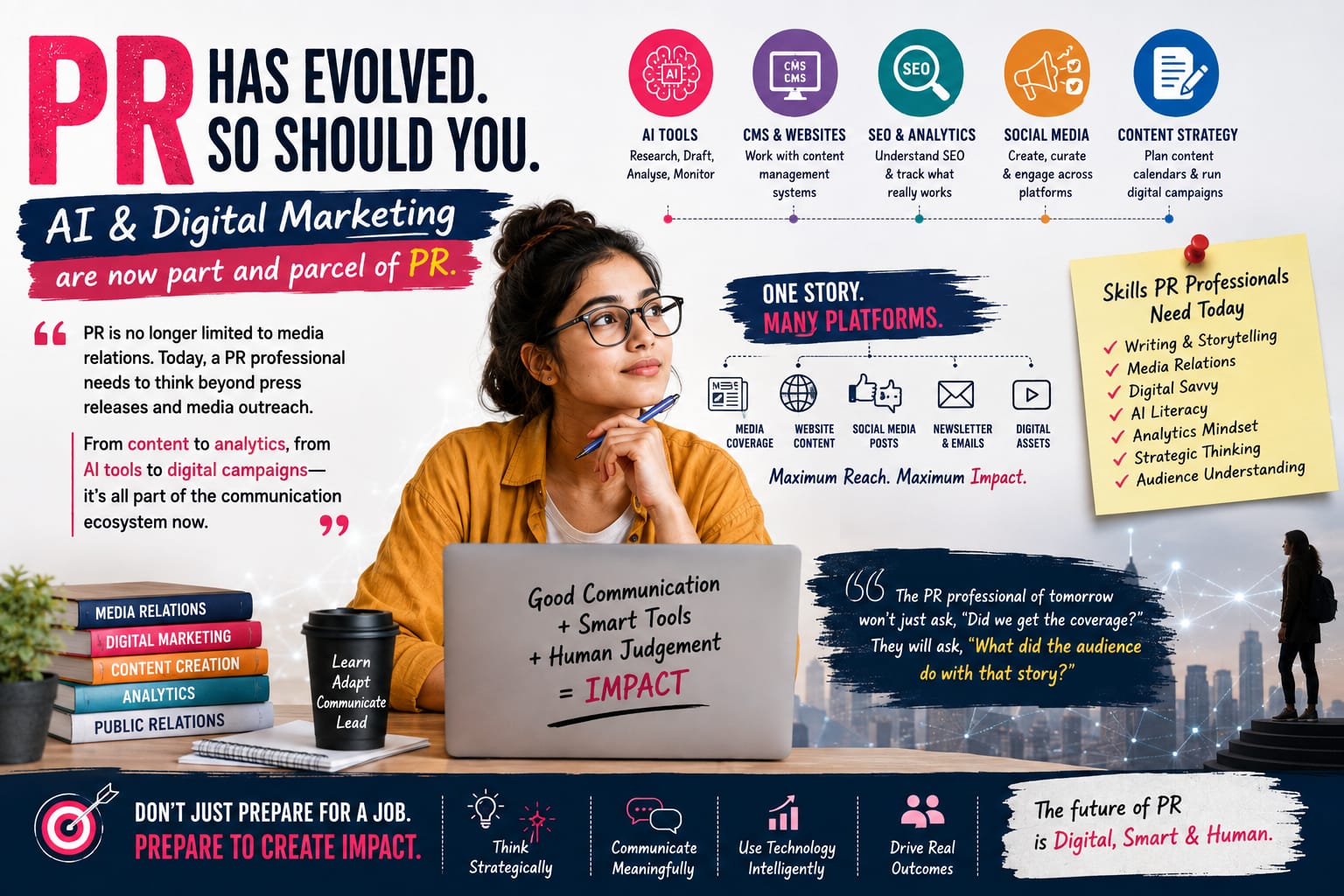
When I started working in PR, the skill set expected from a young communication professional was quite different. Understanding the media, building relationships with journalists, writing a good press release, and knowing how to pitch a story were at the heart of the job.
Those skills still matter. In fact, they remain the foundation of good PR. But the PR industry has changed dramatically, and anyone entering the profession today needs to understand that PR is no longer limited to media relations.
AI and digital marketing have become part and parcel of communication.
For young people studying mass communication, journalism, public relations, or advertising, this is something that cannot be ignored. Knowing how to write well is important, but it is no longer enough to simply write a press release and send it to a journalist.
Today, you may be expected to understand how content moves across websites, social media, and digital platforms. You may have to work with a content management system, understand basic website content, coordinate with digital marketing teams, track online coverage, understand SEO, create social media content, and use analytics to understand whether your communication is actually reaching the right audience.
And now, there is AI.
AI is changing how communication professionals research, brainstorm, draft, analyse, and even monitor conversations. But I don't believe AI will replace good PR professionals. What it will do is make the difference between someone who understands communication and someone who simply knows how to write even more visible.
A young PR professional should therefore learn how to use AI as a tool while developing the judgement to know what should be written, how it should be written, who should receive it, and what makes a story genuinely newsworthy.
That human judgement cannot simply be automated.
There is another important change. PR and digital marketing no longer work in completely separate boxes. A PR campaign can generate media coverage, but that coverage can then become social media content, website content, LinkedIn posts, newsletters, and other digital assets. A good communication professional needs to understand this entire journey.
This is why I would strongly encourage young communication professionals not to wait until they get their first job to learn these skills.
Learn the basics of a CMS. Understand how websites work. Learn the fundamentals of SEO and digital content. Understand social media platforms. Learn how to read basic analytics. Explore AI tools. Understand content calendars and digital campaigns.
You don't need to become a software developer or a full-time digital marketer. But you should be comfortable working alongside these functions.
Because when a PR agency or corporate communication team hires a fresher today, they are increasingly looking for someone who can do more than just write.
They want someone who can think of a story, understand the audience, create the right content, work across platforms, use technology intelligently, and understand how communication delivers an outcome.
The good news is that young professionals have an advantage that many of us entering the industry years ago did not have. You have access to tools, platforms, courses, and AI that can help you learn these skills much faster.
So, if you are studying mass communication, journalism, PR, or advertising and preparing for your first job, don't think of PR, digital, content, AI, and marketing as separate subjects.
They are increasingly becoming different parts of the same communication ecosystem.
The PR professional of tomorrow will not just ask, “Did we get the coverage?”
They will also ask, “What did the audience do with that story?”
And that is where the future of PR is headed.