
The Reuters Institute’s Digital News Report 2026, published on 16 June by Jim Egan and colleagues at the University of Oxford, is the fifteenth edition of the most comprehensive study of news consumption in the world — almost 100,000 people surveyed across 48 markets. For anyone responsible for reaching an audience, its conclusion is unusually direct: the news environment is now more platform-based, more video-led and more creator-shaped than at any point the survey has tracked, and, in the same breath, less trusted and harder to reach through the channels organisations own.
A briefing for communication leaders · Based on the Reuters Institute Digital News Report 2026 (Egan et al., University of Oxford, published 16 June 2026).
01 · Where attention lives
Platforms have overtaken the channels you control
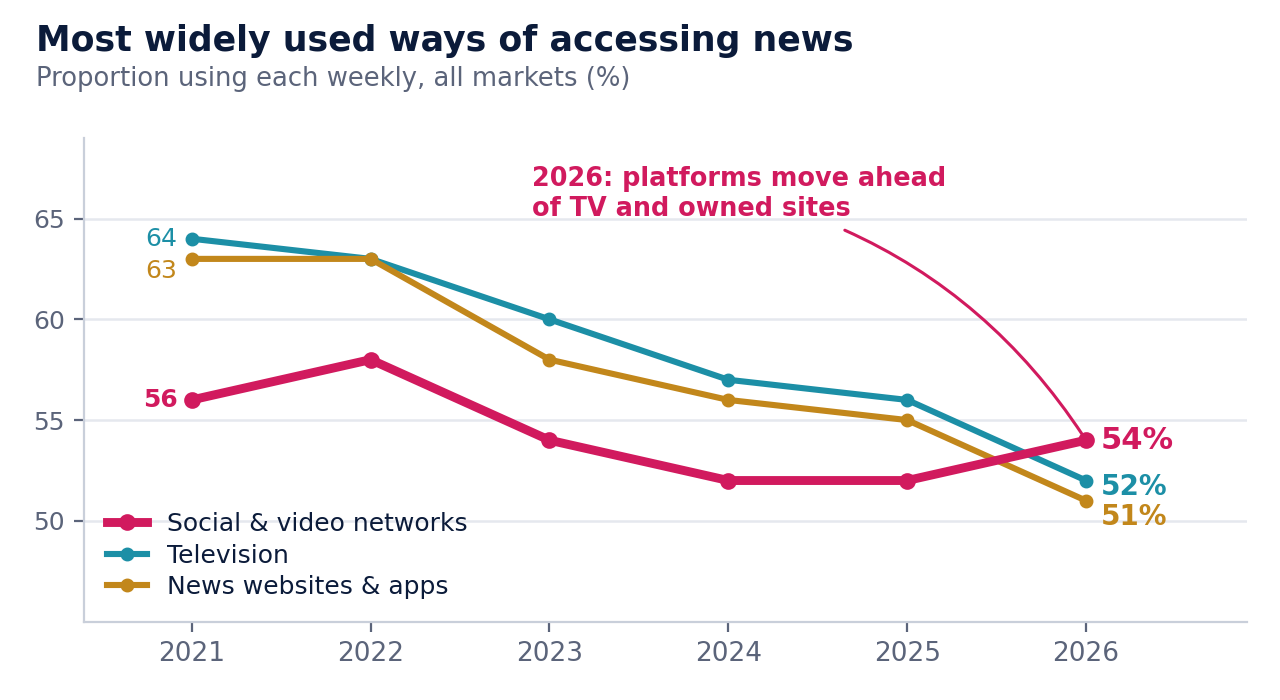
The headline finding is a crossover. For the first time at the global level, social media and video networks (54%) are the single most widely used way of accessing news, ahead of broadcast television (52%) and — the detail that should concentrate every communicator’s mind — ahead of news organisations’ own websites and apps (51%). Direct visits to owned properties have fallen twelve points since 2020; television is down thirteen. The report is emphatic that this is no longer a youth story: the change is happening across every age group, with only the over-55s still leaning on legacy sources. Some of it is supply-driven as much as demand-driven, with platforms actively surfacing more news, but the direction of travel is unmistakable.
The lesson for leaders is structural. The places where most people now meet information are, by definition, channels you neither own nor fully control. And the shift is durable: the report finds that 56% of 18–24-year-olds have never regularly read a newspaper, and a clear majority of under-35s name social, video or AI as their main route to news. The audiences entering their prime earning and decision-making years will not “grow into” the habits of their parents. Build for the world as it is becoming, not the one your media list was made for.
02 · The format shift
Audiences want to watch, not read — and not only in clips
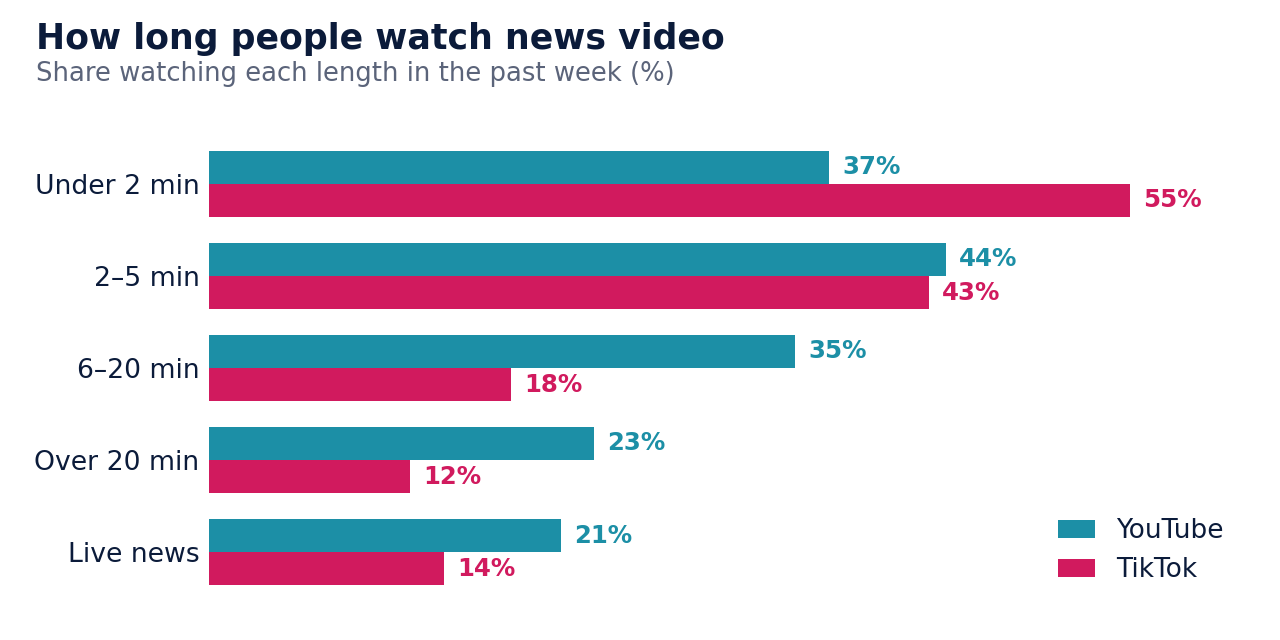
The shift is not only about where people get news but how. The report finds that 77% now watch online news video every week, with a majority doing so in every market it covers — most of it on YouTube, Instagram, TikTok and Facebook. Crucially for communicators, this is no longer a short-clip story: while TikTok viewing skews to videos under two minutes, a quarter of those who follow news on YouTube watch for more than twenty minutes, and a fifth go there for live coverage. Explanation, depth and live reporting now travel on video, not only the fifteen-second hook.
The catch is ownership. Video consumption on news organisations’ own sites and apps has fallen five points in a year and ten since 2021 — the appetite is real and growing, but it is increasingly satisfied on platforms publishers do not control. For leaders the implication is twofold: build genuine platform-native video capability rather than repurposing print, and drop the assumption that “video” means only short form. The audiences you most want to reach will watch something longer — if it earns their attention.
03 · The reputation backdrop
Your narrative now travels through low-trust terrain
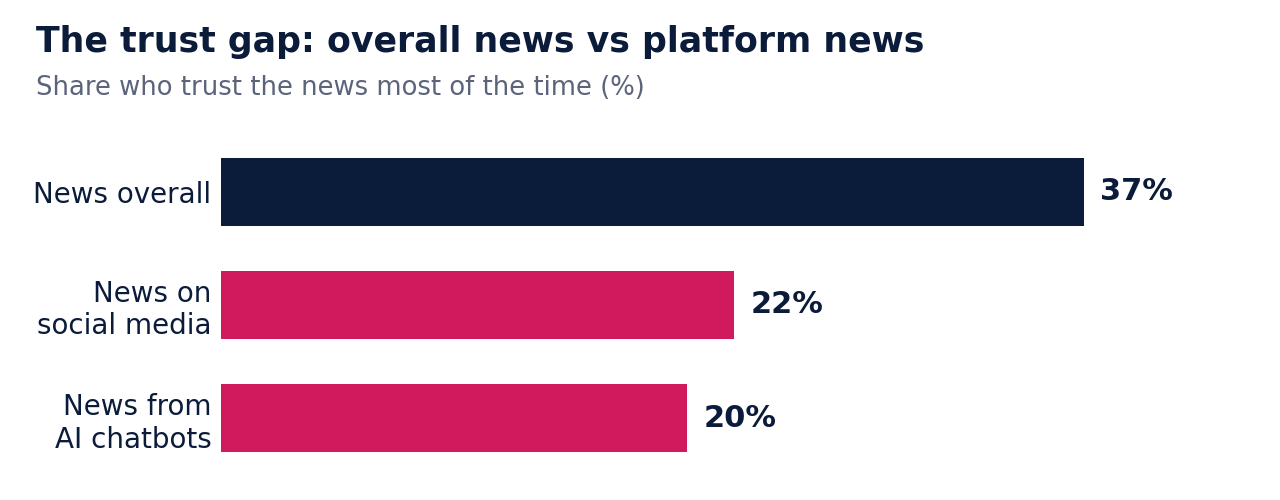
Trust is the second story, and for communicators the more consequential one. Trust in news has fallen to 37% globally — and to just 25% in the United States. The report identifies a “trust gap” that should shape every campaign plan: people trust news on social media (22%) and from AI chatbots (20%) markedly less than news overall, yet that is precisely where attention is migrating. Sixty-two percent now worry about what is real and fake online. Some of this reflects forces beyond journalism — falling trust in institutions and leaders generally — but the effect on your message is the same.
There is one consolation the report is careful to flag: trust in the most established individual news brands is holding up better than trust in news overall — proof that credibility, once earned, still travels. But the channels that deliver reach also lend your message the least credibility. Messenger choice, verifiable substance and trusted third-party voices are no longer refinements; they are how you offset the credibility discount the platform applies.
04 · The new intermediaries
AI answers and creators now sit between you and the public
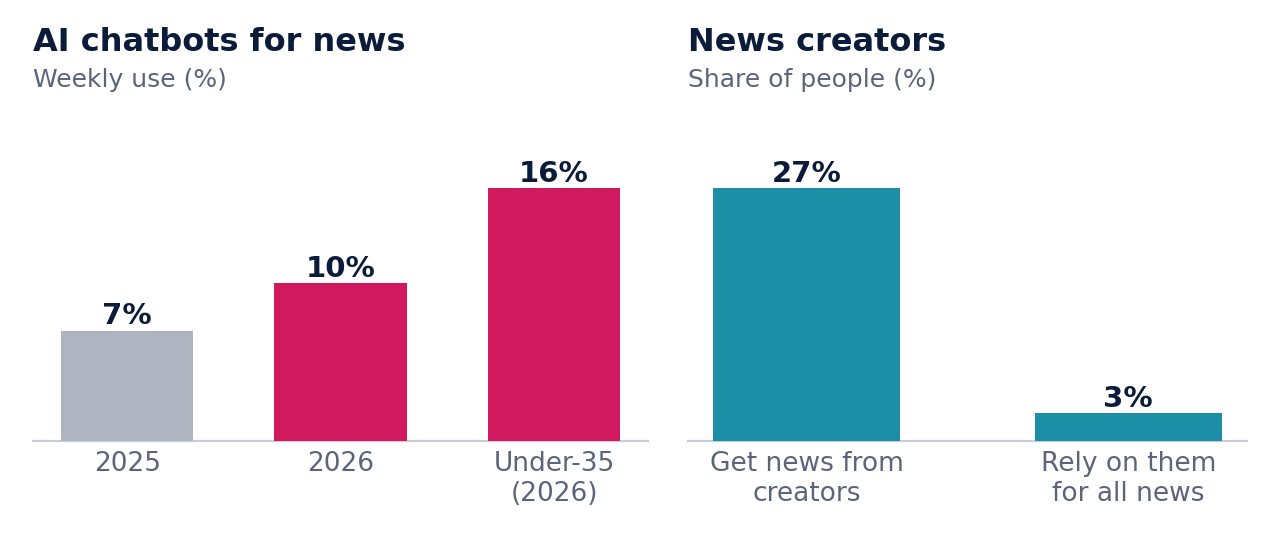
Two newer forces are redrawing the route to your audience. Weekly use of AI chatbots for news has risen from 7% to 10% — and to 16% among the under-35s — turning answer engines into an emerging layer between a message and the public, much as search and social did before them. Trust in those answers remains low, at 20%, and being accurately cited and surfaced within them is fast becoming the next discipline after search and social. Separately, 27% of people now get some news from individual creators and influencers.
The report’s reassurance is that creators mostly complement rather than replace established media — only 3% rely on them alone — and that audiences find them more relatable, if less impartial, than traditional outlets. For leaders, both are opportunities as much as threats: make sure your organisation is represented accurately in AI-generated answers, and treat credible creators as a legitimate channel to audiences your owned media can no longer reach.
05 · What endures
The fundamentals still pay
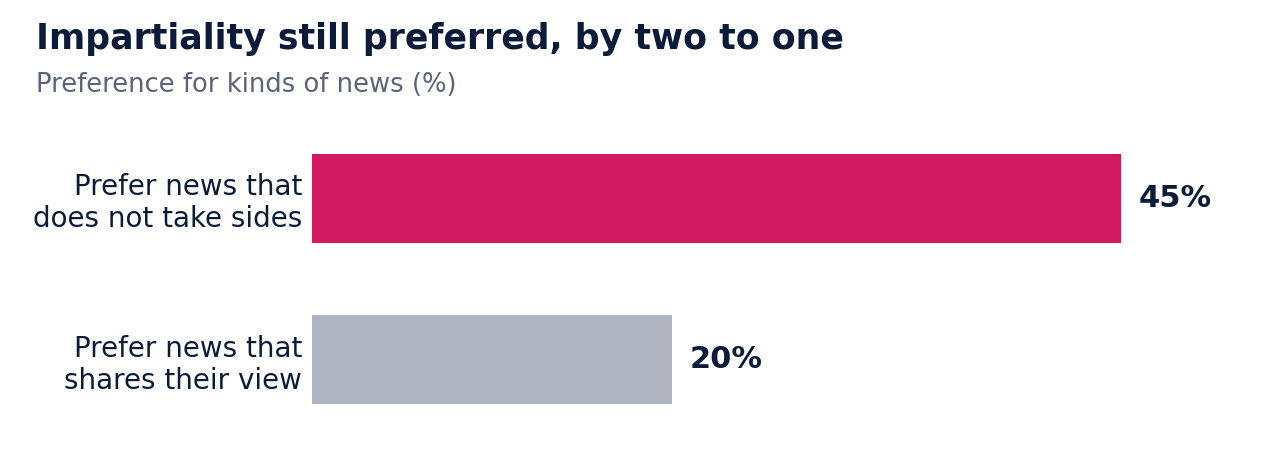
Amid the volatility, the report offers something steadying. Audiences still want impartiality: 45% prefer news that does not take sides, outnumbering those who prefer news that confirms their views by more than two to one. The appetite for credible, even-handed information has not faded — it has simply relocated to harder-to-reach places. That points to three priorities for the leadership agenda:
- Rebuild distribution around platforms and video. Owned channels now reach a shrinking and ageing share of the audience; treat platform-native, video-first publishing as the default, not an experiment.
- Treat trust as the precondition for reach, not an afterthought. Invest in the spokespeople, evidence and partners who can carry credibility into low-trust feeds.
- Get ahead of the AI and creator layers now, while news use of them is still forming, rather than reacting once they harden into gatekeepers.
Treat this report not as a forecast to brace against but as a map of where attention has already gone. The audience has moved. The organisations that move with it — clearly, credibly, and to where people actually are — will be the ones still being heard.
Report and credits
Reuters Institute for the Study of Journalism · University of Oxford
Digital News Report 2026, published 16 June 2026. The fifteenth annual edition, based on a survey of almost 100,000 people across 48 markets.
Authors: Jim Egan (lead author), Craig T. Robertson, Amy Ross Arguedas, Nic Newman, Rasmus Nielsen, Mitali Mukherjee and Richard Fletcher. Main sponsor: Google News Initiative.
Source: reutersinstitute.politics.ox.ac.uk/digital-news-report/2026
This briefing is an independent commentary prepared for communication leaders; the underlying research, data and key findings belong to the Reuters Institute for the Study of Journalism, University of Oxford.
At 3M Media Works, we help leadership teams navigate exactly this kind of shift — sharpening narrative, choosing the right channels, and building the credibility that survives a low-trust feed. Reach us at info@3mmediaworks.com.