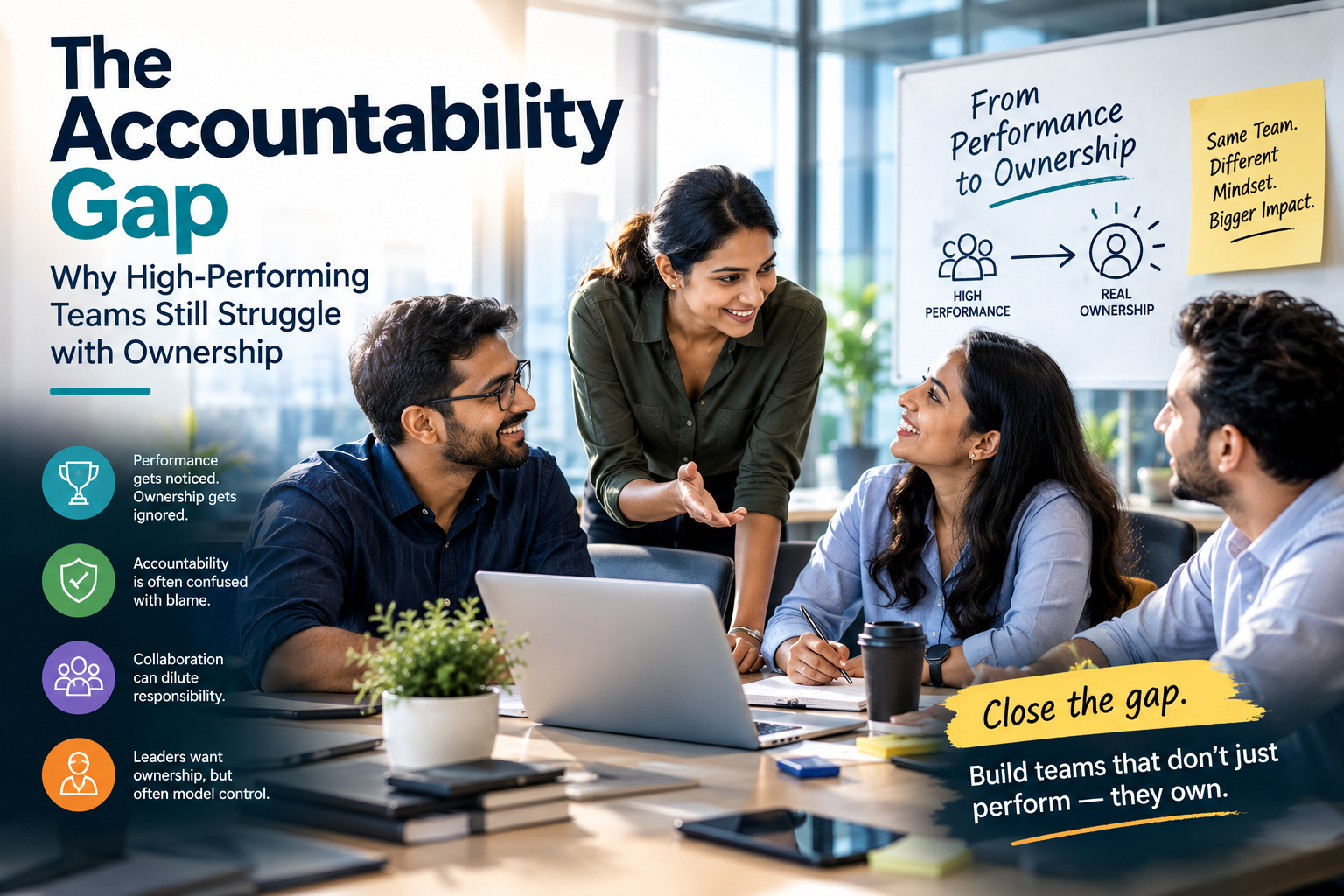
Every leader has experienced it. A team has talented people, strong credentials, and the right intentions, yet deadlines slip, decisions take longer than they should and when something goes wrong, responsibility starts moving from one person to another.
The problem is not necessarily performance. A team can be highly capable and still struggle with ownership. That gap between being able to deliver and being willing to own the outcome is where organizations often lose momentum.
Accountability is often treated as another word for performance, but the two are not the same. Performance is largely about capability, whether people have the skills and resources to deliver. Accountability is about ownership, whether they feel responsible for seeing an outcome through. And creating one does not automatically create the other.
When Performance Is Rewarded, but Ownership Goes Unrecognized
Most organizations have well-defined ways to measure what employees deliver. Far fewer explicitly recognize how they take ownership.
Consider the difference between the employee who stays up late to fix a recurring operational problem and the one who identifies the underlying issue, documents the solution, and puts a process in place to prevent it from happening again. The first response is visible and often celebrated. The second is quieter, but potentially more valuable over time.
When organizations consistently reward heroics, employees can learn that being the person who saves the day is more visible than being the person who prevents the problem in the first place. Ownership is rarely dramatic. It is often found in follow-ups, closing open loops, documenting decisions, raising risks early, and stepping forward to solve an issue even when it sits outside a formal job description.
If ownership is absent from performance conversations and recognition systems, organizations should not be surprised when employees optimize for measurable delivery rather than long-term outcomes.
When Accountability Becomes Synonymous with Blame
Another challenge is the way accountability is perceived. In some workplaces, being "held accountable" has come to mean being singled out when something goes wrong, being questioned publicly or being held responsible for a failure.
In such an environment, even highly capable employees can become defensive. They may copy more people on emails, avoid making decisions without extensive approvals or document every dependency to protect themselves if something goes wrong.
That behaviour does not necessarily indicate a lack of commitment. It can be a response to a system in which taking ownership feels personally risky.
A healthier accountability culture asks a different question. Instead of asking, "Who is responsible for what went wrong?", it asks, "Who is going to help fix it, and what do we need to change so it does not happen again?"
The first approach can create defensiveness. The second creates space for responsibility and learning.
When Collaboration Dilutes Ownership
Modern organizations rightly emphasize collaboration. Complex problems rarely belong to a single function, and solving them often requires input from multiple teams.
But collaboration without clear ownership can create an unexpected problem: responsibility becomes diluted.
A project may involve product, technology, marketing, sales, operations, and customer teams, with everyone contributing but no single person clearly responsible for driving the outcome. Decisions get stuck in long email chains and messaging threads, while everyone assumes someone else will close the loop.
The answer is not less collaboration. It is clear ownership within collaboration.
For every important initiative or outcome, there should be clarity on who is ultimately responsible for moving it forward. Teams can contribute, advise and execute, but one person should have the authority and responsibility to connect the pieces and drive the outcome to completion.
Leaders Must Model the Ownership They Expect
There is also a leadership dimension that organizations cannot ignore.
Leaders often ask their teams to take ownership, but ownership becomes difficult when every decision is second-guessed. If employees are asked to manage an outcome but leaders frequently override decisions, demand constant status updates or intervene in every detail, the message becomes contradictory.
Ownership requires trust.
That does not mean leaders should step away completely. It means providing clarity around the why, defining the expected outcome and establishing appropriate guardrails, while allowing teams greater freedom over the how.
The more capable the team, the more important this balance becomes. High-performing professionals generally do not need every step prescribed to them. They need context, clarity and the confidence that they have room to make decisions.
Closing the Accountability Gap
Closing the accountability gap does not necessarily require more meetings, dashboards or layers of performance measurement. It requires organizations to redesign the conditions in which ownership happens.
The first step is to put one clear name against every critical outcome. Teams can work collectively, but someone should be clearly responsible for driving the initiative and closing the loop.
The second is to define what "done" actually means. A project is not necessarily complete because a product has launched or a task has been checked off. Is success measured by delivery, adoption, customer value or business impact? Without a clear finish line, accountability becomes difficult to establish.
The third is to separate learning from blame. Post-mortems should focus on understanding what happened, where the system failed and what can be improved, rather than simply identifying an individual to blame. When employees know that raising a problem will not automatically make them the problem, they are more likely to surface risks early and take responsibility for solving them.
Finally, organizations need to recognize the quiet, consistent forms of ownership. Celebrate the person who spotted the risk before it became a crisis, closed the difficult follow-up, helped another team succeed, or created a process that prevented a recurring problem. What organizations recognize and reward eventually becomes part of their culture.
High-performing teams do not struggle with ownership because their people lack ambition or ability. Often, they struggle because the systems around them make ownership unclear, risky, or invisible.
The answer is therefore not simply to demand more accountability from employees. It is to create an environment where taking ownership is clearly defined, supported by trust, and recognized as a meaningful part of performance.
Fix the conditions around accountability, and ownership has a much better chance of becoming the norm.