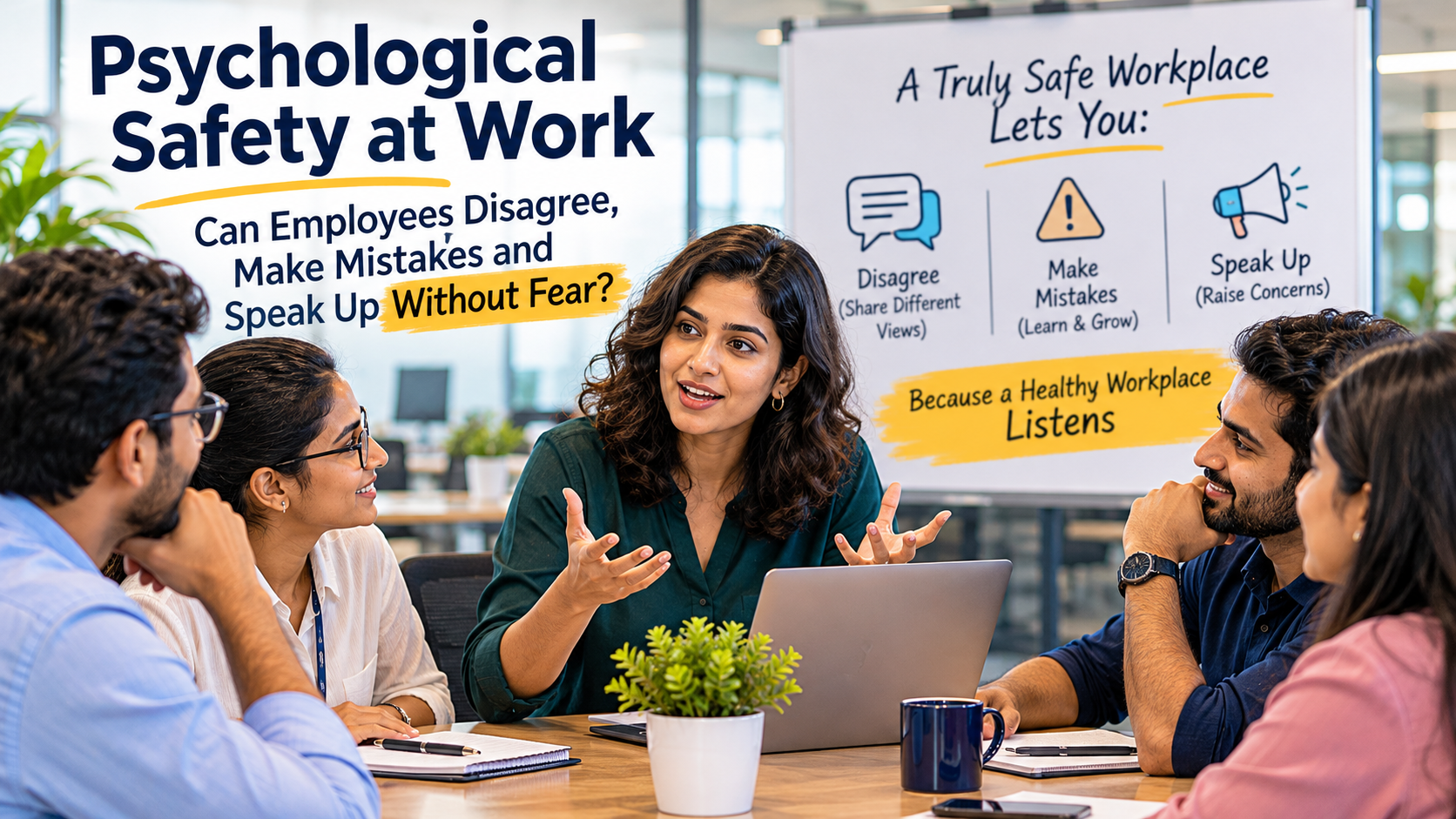
In many workplaces, employees are not necessarily afraid of the work itself, but of the consequences of questioning decisions, admitting mistakes or expressing a different point of view. The fear of being judged, criticised or penalised can prevent people from speaking honestly, even when their input could benefit the organisation.
This is where psychological safety becomes important. Psychological safety is not about creating an environment where everyone agrees or avoids difficult conversations. It is about building a culture where people can express themselves honestly without worrying about negative consequences.
What happens when psychological safety is missing?
The absence of psychological safety often shows up in everyday workplace behaviour.
-
Employees readily agree with decisions during meetings while expressing their actual concerns privately afterwards.
-
Junior team members hesitate to point out mistakes made by senior colleagues because they fear being questioned or judged.
-
Failed projects are rarely discussed openly, preventing teams from understanding what went wrong and avoiding similar mistakes in the future.
-
Employees begin prefacing questions with apologies, often assuming that their doubts may be considered insignificant or uninformed.
The consequences extend beyond employee morale. When people hesitate to share concerns, organisations lose valuable perspectives, miss opportunities for innovation and risk making decisions without complete information. Over time, this can also affect work quality, employee confidence and retention.
What does psychological safety look like in practice?
A psychologically safe workplace gives employees three important freedoms.
1. The freedom to disagree
In high-trust teams, questioning an idea is not interpreted as challenging someone's authority. Different viewpoints are welcomed because they can help identify gaps, improve decisions and strengthen outcomes.
Pixar's Braintrust meetings, for instance, are known for encouraging candid feedback on creative projects. The objective is to improve the work rather than protect individual egos.
Leaders can encourage this behaviour by moving away from questions such as "Does everyone agree?" and instead asking, "What might we be overlooking?" or "Does anyone have a different perspective?"
2. The freedom to make mistakes
When employees believe that every mistake will invite criticism or punishment, they are more likely to conceal problems than report them. This prevents organisations from identifying risks early and learning from experience.
Leaders need to distinguish between errors arising from negligence, mistakes caused by systemic gaps and failures resulting from well-intentioned experimentation. Each requires a different response: accountability and coaching, improvements to processes, or an opportunity to learn and innovate.
The objective is not to eliminate accountability, but to ensure that mistakes become opportunities for improvement rather than reasons for fear.
3. The freedom to speak up
Speaking up involves more than reporting problems. It includes asking questions, admitting uncertainty, seeking assistance and raising concerns before they develop into larger issues.
However, employees need to believe that their voices will be taken seriously. If concerns are repeatedly ignored or dismissed, they may eventually stop sharing them. Organisations must therefore demonstrate that speaking up leads to meaningful consideration and, where necessary, action.
How can leaders build psychological safety?
Psychological safety is not established through policy documents or occasional town halls. It develops through consistent leadership behaviour and everyday interactions.
-
Lead by acknowledging vulnerability: Leaders who openly admit mistakes, acknowledge uncertainty or ask for help demonstrate that nobody is expected to have all the answers.
-
Appreciate employees who raise concerns: Recognising people who question decisions, identify risks or offer alternative perspectives encourages others to contribute honestly.
-
Create structured opportunities for different opinions: Anonymous feedback, brainstorming sessions and project reviews can help employees express concerns without feeling intimidated by hierarchy.
-
Respond constructively to mistakes: A leader's immediate reaction when an employee reports an error can influence whether others feel safe admitting problems in the future. Instead of reacting defensively, managers should focus on understanding what happened and how it can be addressed.
-
Close the feedback loop: Employees should know what happened after they raised a concern. Communicating the steps taken demonstrates that their opinions are valued and that speaking up makes a difference.
The larger challenge: Moving from authority to trust
Organisations cannot expect employees to speak openly simply because they have been encouraged to do so. Psychological safety must be demonstrated through leadership actions, fair treatment and a culture that values transparency.
Employee responses can provide an important starting point for understanding whether people feel heard, respected and confident enough to express their views.
Ultimately, psychological safety is not about eliminating disagreements or lowering performance expectations. It is about creating an environment where people can challenge ideas, acknowledge mistakes and raise difficult questions while remaining accountable for their work.
The strongest workplaces are not necessarily those where everyone agrees. They are those where employees feel safe enough to disagree, contribute and speak honestly. Because when people are afraid to speak, organisations hear only what employees think is safe to say, not necessarily what they need to hear.