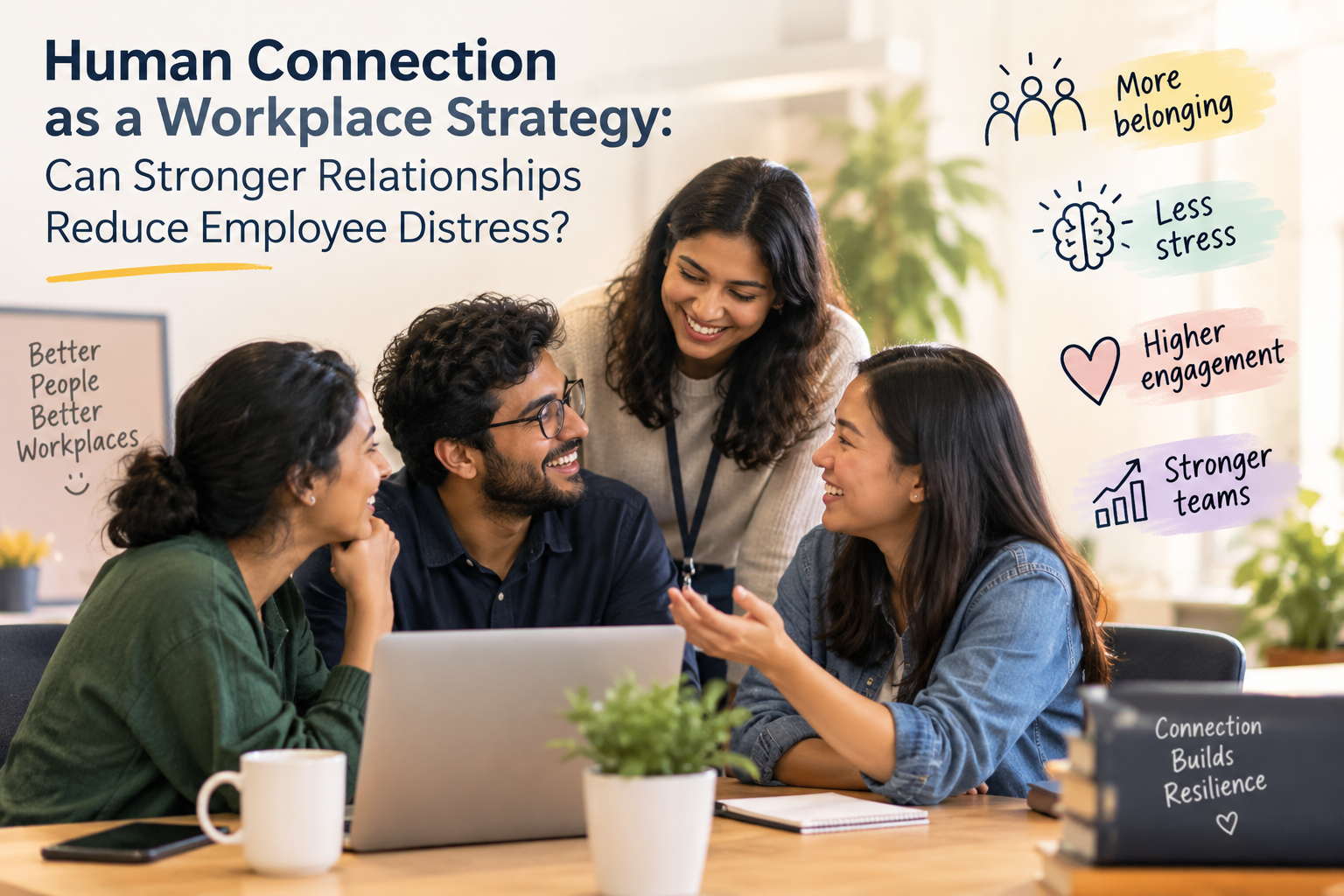
Human Connection as a Workplace Strategy: Can Stronger Relationships Reduce Employee Distress?
For years, organisations have tried to address workplace stress through wellness initiatives such as yoga sessions, counselling helplines, mindfulness apps and team lunches. While these measures can help, they may not address a deeper issue: employees often feel they are dealing with workplace pressures on their own.
Distress is not always a consequence of excessive workload. It can also arise from isolation, a lack of support and the feeling that nobody understands what an employee is going through. This makes human connection more than an interpersonal skill; it is an important part of building a healthier and more sustainable workplace.
Why workplace distress can also be a problem of disconnection
Workplace stress becomes harder to manage when employees face high demands, have limited control over their work and lack adequate support. Organisations may not always be able to reduce every demand, but they can strengthen the support systems available to employees.
When employees feel supported, challenges can become easier to navigate. Without that support, even routine setbacks may feel overwhelming. The objective, therefore, should be to create workplaces where asking for help is accepted and employees do not feel they must manage every challenge independently.
What meaningful workplace connection looks like
Building stronger relationships does not mean forcing employees to socialise or organising more team-building activities. It means creating an environment where people feel supported, understood and connected to their work.
1. Task connection: Knowing that someone has your back
Employees need to know that their managers understand their workload and that colleagues will step in when demands become difficult to manage. Teams with supportive working relationships are more likely to raise concerns early, seek assistance and address problems before they escalate.
Organisations can encourage this by introducing brief check-ins during team meetings. Instead of focusing exclusively on project updates, managers can ask employees what is holding them back, where they need support and whether their priorities are manageable. Such conversations can help identify problems before they affect performance or wellbeing.
2. Social connection: Recognising the person behind the role
Hybrid and remote working have reduced many of the informal interactions that once helped colleagues build trust. Casual conversations before meetings, lunch breaks and spontaneous exchanges often created a sense of familiarity that formal communication alone cannot replicate.
Organisations can rebuild these opportunities through informal virtual coffees, peer interactions, shared-interest groups and occasional team gatherings. The emphasis should be on creating opportunities for connection without making participation feel compulsory. Genuine relationships develop when employees feel comfortable being themselves, rather than when social interaction becomes another workplace obligation.
3. Purpose connection: Understanding why the work matters
Employees can experience disconnection when their work becomes a series of tasks without a clear sense of purpose. Understanding how individual contributions influence customers, communities or business outcomes can restore meaning and motivation.
Leaders should communicate the impact of employees' work, not just the targets they achieve. For example, instead of simply recognising the number of customer requests resolved, a manager could explain how the team's efforts helped customers access essential services more efficiently. Connecting everyday responsibilities to meaningful outcomes can strengthen employees' sense of contribution and belonging.
What organisations can gain from investing in connection
Strong workplace relationships can help employees access practical support, learn from colleagues, discuss difficulties and feel more confident navigating uncertainty.
Connection can also help create psychological safety, an environment where people feel comfortable asking questions, admitting mistakes and expressing concerns without fearing humiliation or retaliation. When employees feel safe enough to speak honestly, managers have a better chance of identifying problems and addressing them before they escalate.
However, organisations should be cautious about treating connection as a guaranteed solution to burnout or attributing specific improvements in productivity to relationships without reliable evidence. The impact depends on the quality of workplace relationships, leadership behaviour and the broader working environment.
Meaningful connection is most effective when supported by fair policies, manageable workloads, adequate resources and access to professional mental health support where needed.
The manager's role in building stronger connections
Managers have a significant influence on employees' everyday experiences at work. Their responses to concerns, approach to feedback and willingness to listen can determine whether employees feel supported or hesitate to seek help.
The answer is not to turn managers into therapists, but to equip them to recognise concerns, listen empathetically and connect employees with appropriate support.
Three practices can make a difference:
-
Look beyond the first response. A routine “How are you?” may invite a brief “I'm fine.” A thoughtful follow-up, such as asking how the employee has been managing their workload, can open the door to a more meaningful conversation.
-
Notice changes in behaviour. Reduced participation, withdrawal from colleagues or reluctance to ask for help may indicate that an employee needs support. Managers should approach these changes with curiosity and compassion rather than making assumptions about their mental health.
-
Make it acceptable to acknowledge difficulties. Leaders who speak honestly about challenges, uncertainty and the importance of seeking help can encourage employees to do the same. Vulnerability, when expressed appropriately, can make leadership more approachable and strengthen trust.
Can stronger relationships reduce workplace distress?
They can help, but connection cannot compensate for a fundamentally unhealthy working environment. Employees cannot be expected to overcome excessive workloads, unfair treatment, inadequate compensation or poor management simply by developing stronger relationships with colleagues.
Organisations must address the structural causes of distress while creating opportunities for employees to support one another. This requires combining meaningful relationships with fair expectations, supportive leadership, employee autonomy and accessible wellbeing resources.
When these elements work together, human connection can act as an important buffer against workplace pressure, helping employees feel less isolated and better equipped to navigate challenges.
Ultimately, a healthy workplace is not one where employees never experience stress. It is one where they feel supported enough to speak up, seek help and work through challenges without feeling alone.