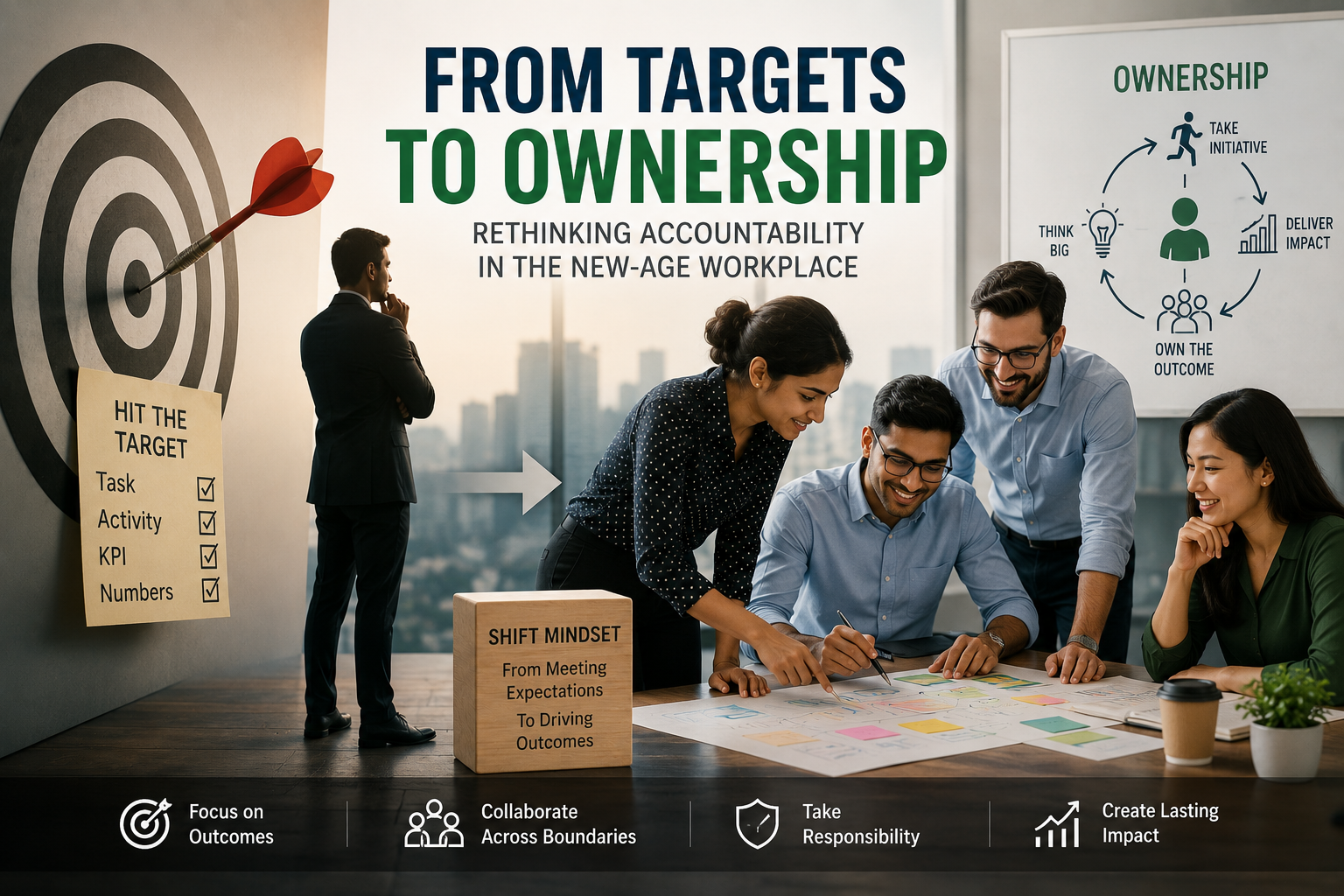
For decades, workplace accountability was largely defined by a simple question: Did you meet your target? Did you close the deal, deliver on time, achieve the KPI, or hit the number on the dashboard? This approach worked well when work was more predictable, processes were linear, and roles were clearly defined. But the modern workplace has changed dramatically. It is hybrid, AI-enabled, collaborative, and constantly evolving. Targets still matter, but they are no longer enough. The bigger question organizations need to ask today is not simply whether an employee met a target, but whether they took ownership of the outcome.
Target-based accountability can sometimes encourage employees to focus more on numbers than on meaningful outcomes. When performance is judged primarily through individual metrics, people may find ways to meet short-term goals at the expense of long-term value. Sales may be pushed into the next quarter, quality may be compromised to meet deadlines, and teams may become reluctant to take on responsibilities that fall outside their KPIs. This can create a mindset where employees focus on completing what they have been assigned rather than understanding the larger business problem. Over time, "That’s not my responsibility" can become an easy response when challenges cross organizational boundaries.
There is also a deeper problem with a purely target-driven culture: the fear of failure. When missing a number is viewed more negatively than learning from a mistake, employees can become cautious. They may avoid experimentation, delay raising concerns, or hide problems until they become bigger issues. In a rapidly changing business environment, this can be particularly damaging. Customer expectations can shift overnight, products evolve continuously, and successful outcomes increasingly depend on collaboration across functions. Organizations therefore need employees who are willing to think beyond their individual scorecards.
Ownership represents a fundamental shift in how accountability is understood. It moves employees from asking, "What is my KPI?" to asking, "What problem are we trying to solve?" It means looking beyond activity and focusing on impact. A sales professional with an ownership mindset does not simply focus on closing a deal but considers whether the customer is actually receiving value. Similarly, a developer does not simply deliver code but thinks about whether the product is solving a genuine user problem. The focus moves from "I completed my part" to "Did we achieve what we set out to achieve?"
Ownership also means taking responsibility for outcomes beyond a narrow job description. An ownership culture encourages people to stay engaged until the problem is resolved. It is not about taking over someone else’s job, but about being willing to step beyond organizational boundaries when the situation demands it. The goal is to follow the problem rather than simply follow the job description.
For ownership to thrive, organizations also need psychological safety. Employees are unlikely to take responsibility or act proactively if they believe that admitting a mistake, raising a concern, or questioning a decision could result in blame. Leaders need to create an environment where people can speak openly about risks and failures. Rewarding transparency, learning, and early intervention can be more valuable than celebrating last-minute heroics. When employees know they can raise difficult issues without fear, they are more likely to act like owners.
Building such a culture requires changes at multiple levels. Leaders need to move from simply assigning tasks to framing problems and providing context. Instead of telling an employee to generate a specific number of leads, for example, a leader can explain the broader business challenge and give the employee the freedom to determine the best approach. Clear expectations, decision-making boundaries, and trust can create much stronger accountability than constant monitoring.
Organizations also need to rethink what they reward. If recognition is based entirely on individual target achievement, employees may naturally prioritize their own numbers over collective success. Companies should also recognize collaboration, mentorship, knowledge-sharing, early identification of risks, and efforts that prevent problems from becoming crises. Employees are more likely to take ownership when they understand how decisions are made and feel that their contributions can influence outcomes.
For individuals, ownership often begins with a small but powerful change in mindset. Instead of asking, "Who is responsible for solving this?" employees can ask, "What can I do to move this forward?" Taking a few minutes after a project to reflect on what was intended, what actually happened, and what could be done differently can turn everyday experiences into valuable learning. Documenting lessons, not just achievements, can also help build a culture where improvement is valued alongside performance.
AI is making it easier than ever for organizations to track targets, automate reports, and measure productivity. But there are aspects of accountability that technology cannot easily replace: initiative, judgment, responsibility, care, and pride in the outcome. These qualities become even more important as AI takes over routine tasks and employees are expected to make more complex decisions.
In the new-age workplace, the most valuable employees may not always be those who never miss a target. They are the people who understand the bigger picture, take responsibility when things go wrong, collaborate across boundaries, and look for solutions even when no one is watching. Targets can help organizations reach the next quarter, but ownership is what helps them build the future.