For the last two decades, accountability was relatively straightforward. A human made a decision, and a human was responsible for the outcome.
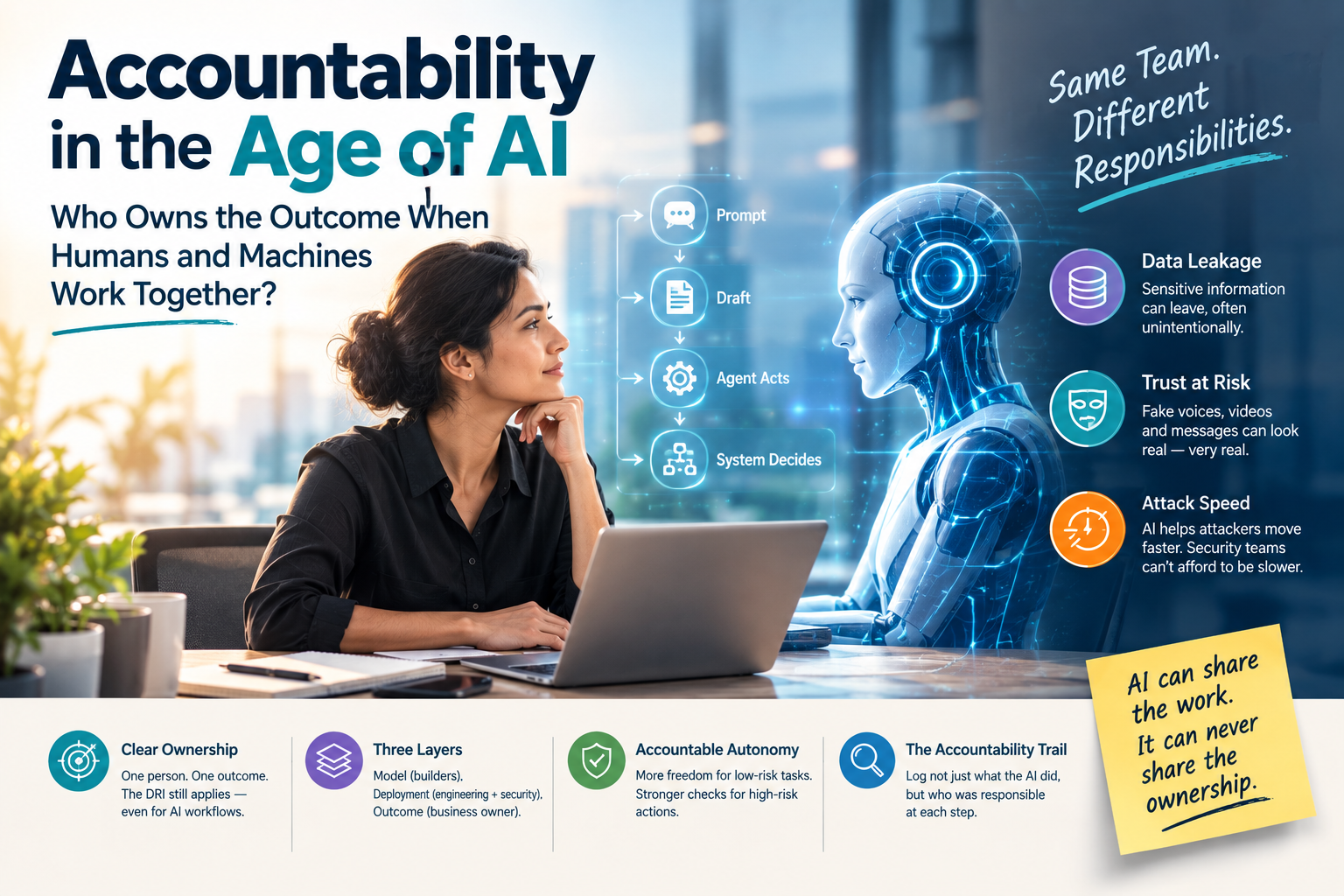
AI is changing that equation. Today, a human may give the prompt, AI may create the output, an agent may take the action, and multiple systems may be involved in the final decision. When everything goes right, it is easy for everyone to take credit. But when something goes wrong, an AI invents a policy, books the wrong vendor, sends inaccurate information to a customer, or exposes sensitive data, the question becomes much harder: Who is responsible?
This is one of the biggest challenges emerging with enterprise AI adoption: greater AI autonomy, but increasingly unclear accountability.
The New Accountability Gap
In the traditional workplace, authority and responsibility were closely connected. The person making the decision generally had the authority to make it and was accountable for the result. AI is beginning to separate those two things.
An AI system may now have the ability to send emails, access databases, recommend decisions, or even approve certain transactions. But AI cannot take responsibility for the consequences. The human organization deploying it still has to.
At the same time, employees may not always have complete visibility into how an AI system arrived at a particular recommendation or decision.
This creates a new accountability gap. And in many cases, the biggest problem is not that the AI made a mistake. It is that no one was clearly responsible for what happened after the AI made the mistake.
Three patterns illustrate this problem.
1. The “AI Did It” Defence
Imagine a company sends a customer-facing report generated by AI, only to discover that some of the information is incorrect. When the customer complains, the explanation is simple: “The model hallucinated.”
But that does not answer the real question: Who decided that the AI-generated content was ready to be sent to the customer?
AI making a mistake does not remove human accountability. Organizations need clear processes that define when AI output can be used directly and when human review is required.
2. The Shared Ownership Trap
Consider an AI agent used by Marketing, developed by Engineering, configured by Product, and connected to data managed by another team.
If that system accidentally exposes sensitive customer information, responsibility can quickly become fragmented. Each team can point to another part of the workflow and say, “That isn't my responsibility.”
The more teams and systems involved, the more important it becomes to have one clearly identified owner.
When everyone owns a piece of the workflow, someone still needs to own the outcome.
3. The Human in Name Only
Many organisations include a human approval step because their processes require one. But putting a person in the workflow does not automatically create accountability.
If an employee is expected to review hundreds of AI-generated decisions every day and simply clicks “Approve” because there is no practical way to examine each one, the human is not really exercising meaningful oversight.
The goal should not be to have a human somewhere in the process. The goal should be to ensure that the human has the context, authority, and time needed to make a meaningful decision.
A practical accountability framework can be built around three principles.
1. The DRI Principle Still Applies to AI
Every important AI-enabled workflow should have a Directly Responsible Individual (DRI).
Not a committee. Not an AI operations team. Not “the system.”
There should be a clearly identified human who owns the business outcome.
If an AI agent makes a series of incorrect bookings, for example, that person is responsible for ensuring the problem is addressed, communicating with affected stakeholders, and improving the controls that allowed it to happen.
AI can perform the task. A human must own the result.
2. Separate the Different Layers of Accountability
Accountability should also be divided according to where decisions are made.
Model accountability: Are the model's capabilities, limitations, safety, and performance properly tested? This sits with the model builders or vendor.
Deployment accountability: Has the AI been deployed with appropriate access controls, security measures, guardrails, and human oversight? This sits with the teams implementing and securing the system.
Outcome accountability: Was the AI output appropriate for the customer, employee, or business decision? This sits with the business owner using the system.
These responsibilities should not be confused.
A marketing leader, for example, may not be responsible for how a model was trained. But they are responsible for ensuring that an AI-generated campaign is appropriate before it reaches thousands of customers.
3. Design for Accountable Autonomy
AI should be given autonomy based on the potential consequences of its actions.
For relatively reversible activities such as summarizing information, drafting content, or conducting research, greater automation may be appropriate.
For actions that are difficult or impossible to reverse, such as transferring money, sending sensitive information externally, deleting data, or sharing personal information, organisations should build in stronger controls, including human approval and clear audit trails.
The principle is simple: The greater the consequence and the harder the action is to reverse, the stronger the human oversight should be.
Trust in AI will not come from creating systems that never make mistakes. That is unrealistic. It will come from creating organizations that know who is responsible when those mistakes happen and what happens next.
As AI becomes more capable, the most valuable skill may not be knowing how to write the perfect prompt. It may be knowing how to own the outcome.
The organisations that successfully scale AI will not simply be those with the most advanced agents. They will be the ones that can answer a basic question for every important automated workflow:
AI can share the work. It cannot share the ownership.